Who Gets to Write the Truth?
Every civilization has a creation myth, a legal code, a canon of truths—written, printed, recorded.
Scrolls. Tablets. Books. It begins with a pen. Not a divine thunderclap. Not a universal consensus. Just a person—writing.
The earliest scribes were considered sacred intermediaries. They etched law into stone. They defined morality in ink. They documented stars, dreams, punishments, and boundaries of the known world. But who were they?
Not the masses. Not the doubters. Not the broken.
The truth was never written by the people who were questioning it. It was written by the ones who could write. And if truth begins as authorship, then we must ask— Who holds the pen today?
Truth as a Story Framed by Power
Science is books. History is books. Religion is books. And books are authored. Authored by people. People with agendas, beliefs, limitations—and sometimes power to protect.
What if “truth” is not what is true, but what is allowed to be printed? A textbook becomes a belief system. A constitution becomes an unquestioned doctrine. A scientific theory becomes a weaponized dogma. The words themselves are ink. But the authority behind them—the gatekeepers—is what binds them into truth.
The Illusion of Objectivity
We were taught in school that knowledge is neutral. That facts are unchangeable. That truths are empirical. But how many “facts” were later proven false? Pluto was a planet—until it wasn’t. Smoking was safe—until it killed. The Earth was flat—until someone sailed off the edge and lived.
Even scientific journals have gatekeepers. Even encyclopedias are curated. Even history, as we know it, is a series of edits. Revisions. Erasures.
And if we trust what’s written simply because it’s written, then we’ve handed over our perception of reality to the highest bidder with a printing press.
The Unwritten Truths
What isn’t taught in schools? What truths never made it past the margins? What oral traditions, suppressed cultures, indigenous sciences, ancient healing methods, and revolutionary philosophies were buried—not because they were untrue—but because they were inconvenient?
Power protects its version of truth. And it silences everything else.
What if truth is not one thing, but a war between narratives? A battlefield where only the loudest—or richest—stories survive?
Authorship as a Form of Reality Creation
If reality is shaped by what we believe… And what we believe is shaped by what we read… Then authorship is not just influence—it is creation. To write is to architect perception. To author a book is to draft a dimension. To name a phenomenon is to frame it.
What we call “mental illness” might have once been called “visionary.” What we now call “alternative” may once have been the norm. What we call “fiction” might hold more reality than the nightly news.
Words decide reality. Which means that authors—those brave enough to question, to imagine, to whisper a new script—become the new architects of truth.
Reclaiming the Pen
If all truths were authored—then they can be re-authored. You can question the rules. You can reframe the past. You can decide that the truths you inherited… were never yours to begin with.
Your thoughts are the raw material. Your voice is the scalpel. Your story is the spell.
What if truth was never handed down? What if it’s waiting to be written by you?
Mindscape and the Mirror
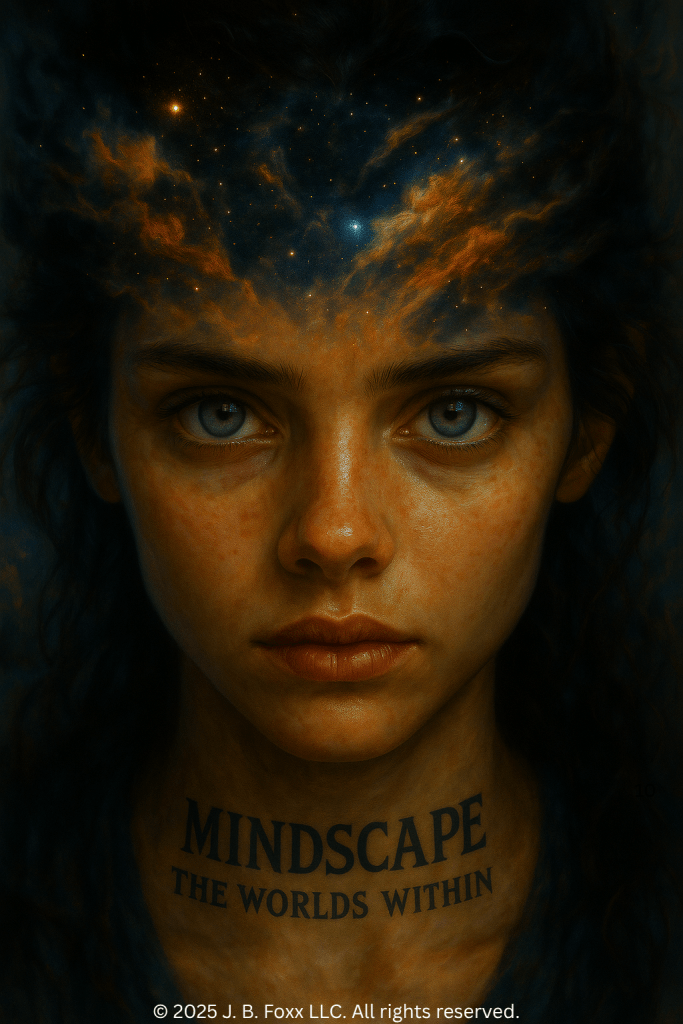
Mindscape: The Worlds Within is not just a collection of stories. It is a rebellion against passive truth. Each tale is a mirror— not to show you what’s real, but to show you that you have always been the author of your reality.
The deeper you go, the more you begin to wonder: What have I believed that was never mine? What laws govern my life that I never questioned? What truth was I taught to worship that no longer feels true?
In the end, the power doesn’t lie in what’s written. It lies in your ability to rewrite it.
The Real Question Is Not “What Is Truth?”
The real question is: Who gets to write it? Who gave them that power? And when will you take the pen back?
You’ve read their version. Now write your own.
 JB Foxx
You must be logged in to post a comment.